July 31, 2026
Stop personalizing your cold email and fix the offer
Personalization was a proxy for effort, but AI killed that. Offers are now the way to stand out.

Cold email has become the punching bag for people pointing at AI's negative impact on GTM.
I get it. My spam folder is more full than ever. Landing in someone's inbox now takes a PhD in DNS records and inbox warming.
Though, a cold email is no different than any other marketing channel. If you're offering something good, no one cares how it got to them.
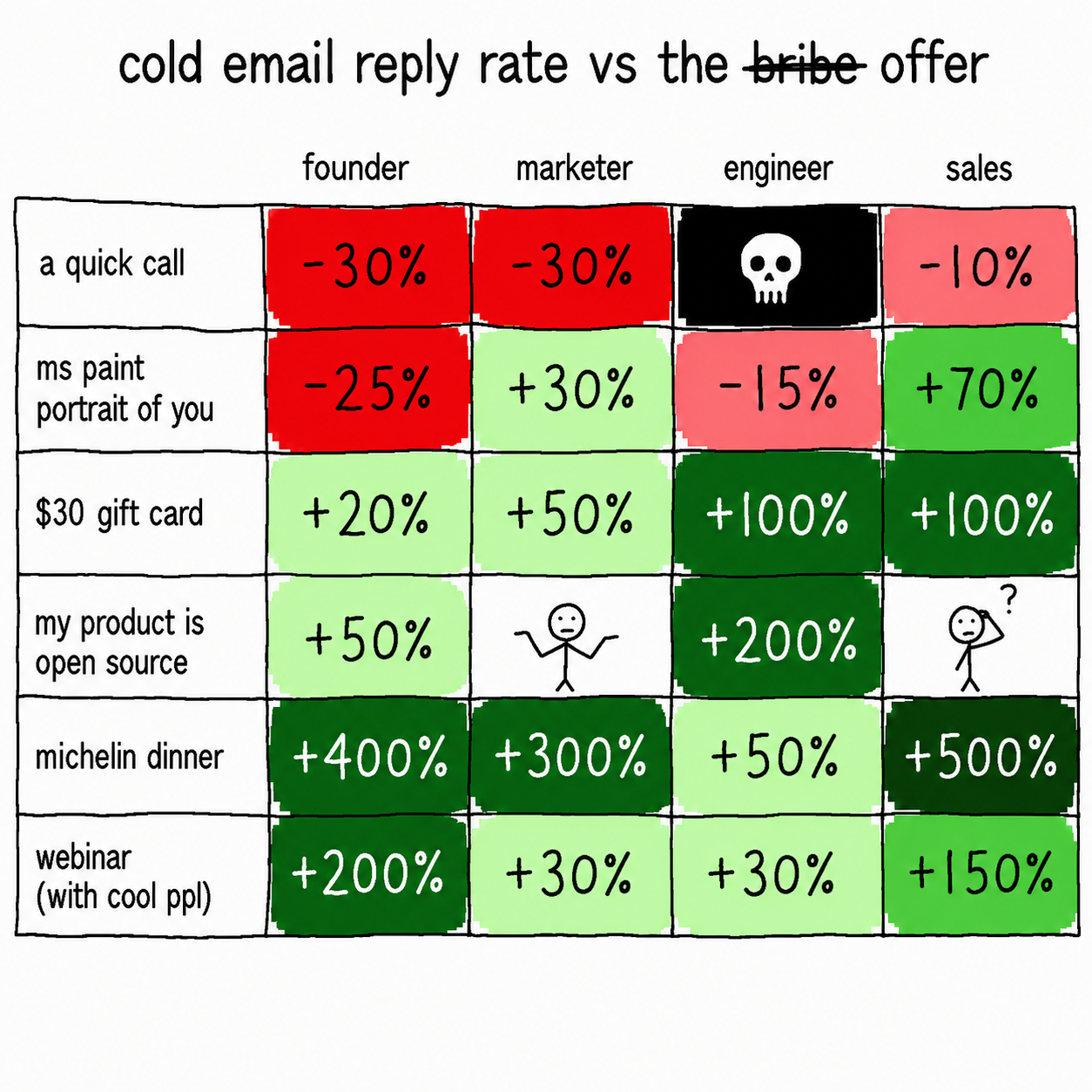
Billboards are impersonal, and I've never heard anyone complain about that. Dinner invites go out over email instead of hand-delivered, and nobody deletes one over it either. So the channel is rarely the problem. It's the offer.
The offer
If your cold email isn't converting, it has nothing to do with whether you referenced their recent podcast appearance or alma mater. You're asking a stranger for 30 minutes so you can sell them something. That's a really selfish demand with nothing in it for them.
So what makes a good offer? The way I think about it, an offer needs to hit one (or more) of these to resonate:
- Scarcity. The best offers give you an advantage your competitors are not getting. The reader has to believe it could run out and slip by if they don't act: limited seats, a hard date, access they can't get another way.
- Relevance. It's required - it doesn't mean you name some random fact from their LinkedIn profile. It means you've done your homework and your offer is actually going to help them.
- Authority. The world is noisy and trust is at a premium. If you're associated with a name they recognize, it tells them your offer is quality and less likely to waste their time.
- Value. They walk away with something even if they never buy from you. A benchmark, an intro, a playbook, a seat at a table they couldn't otherwise get. Or it could even just be airpods - people love airpods.
Most cold emails manage to hit exactly zero of the four.
Take "Saw you're hiring SDRs, thought you might want to chat about our platform". There's nothing scarce about it, the relevance is barely there, and no authority comes attached to it either. Value-wise, the reader gets nothing out of it past the sales pitch. And no amount of personalization is going to save that email.
What does it look like?
Hey {NAME}, we're hosting a dinner next Thursday with sales leaders
from Salesforce, Webflow & Lovable. Just wanted to extend an invite
if you can make it!

https://luma.com/XXXXX
Hey {NAME}, I'm hosting a small workshop with {Cool company 1} and
{Cool company 2}'s growth leads on how they managed to 2x pipeline
through cold emails. Would love to send you an invite if you're
interested in joining.Neither email opens with "I noticed you recently..." or spends three paragraphs on the sender's product. Neither ends with "worth a chat?" The offer is the entire email, and it takes ten seconds to read.
Why it works
In the past, personalization was a proxy for effort. A bespoke email took 15 minutes to write, so receiving one at least signaled that a human on the other end cared enough to do the work.
AI killed that one pretty thoroughly, and inboxes filled up with emails that are "personalized" and mean nothing.
There are few reasons left to spend hours collecting random facts from LinkedIn. "Congrats on the Series B!" "Fellow Waterloo grad here!" Most people spot those scraped lines from the subject. A genuine one still leaves the only question that matters unanswered: what's in this for me?
What can't be faked is the offer. Nobody AI-generates a dinner with sales leaders from three companies their prospect respects. Same with a workshop, where you can't scrape your way to practitioners who actually 2x'd pipeline. That kind of thing takes real work, it just happens earlier now, before any email gets written. The effort moved upstream, from writing the email to building the thing worth emailing about.
That's also why this scales in a way personalization never did. One good offer works for an entire segment, and you only have to write it once - "sales leader at a Series A-C company" is all the targeting you need at that point. The alternative is researching 500 prospects individually, and what you get out of all that research is 500 mediocre emails, all asking for the same 30-minute demo.
If your reply rates are dead, another opening line or enrichment tool will not fix them. Ask two questions:
- Would I have said yes to this one myself, if some stranger sent it to me?
- Do they walk away with something even if they never buy a single thing from me?
If either answer comes back no, put the copy down and go build yourself a better offer.
Good luck!
Get the next post in your inbox
Companies with unfair distribution win. I'm collecting field notes from the world's best operators to help you think through growth.
Join top operators from Zapier, Clay, Lovable.