
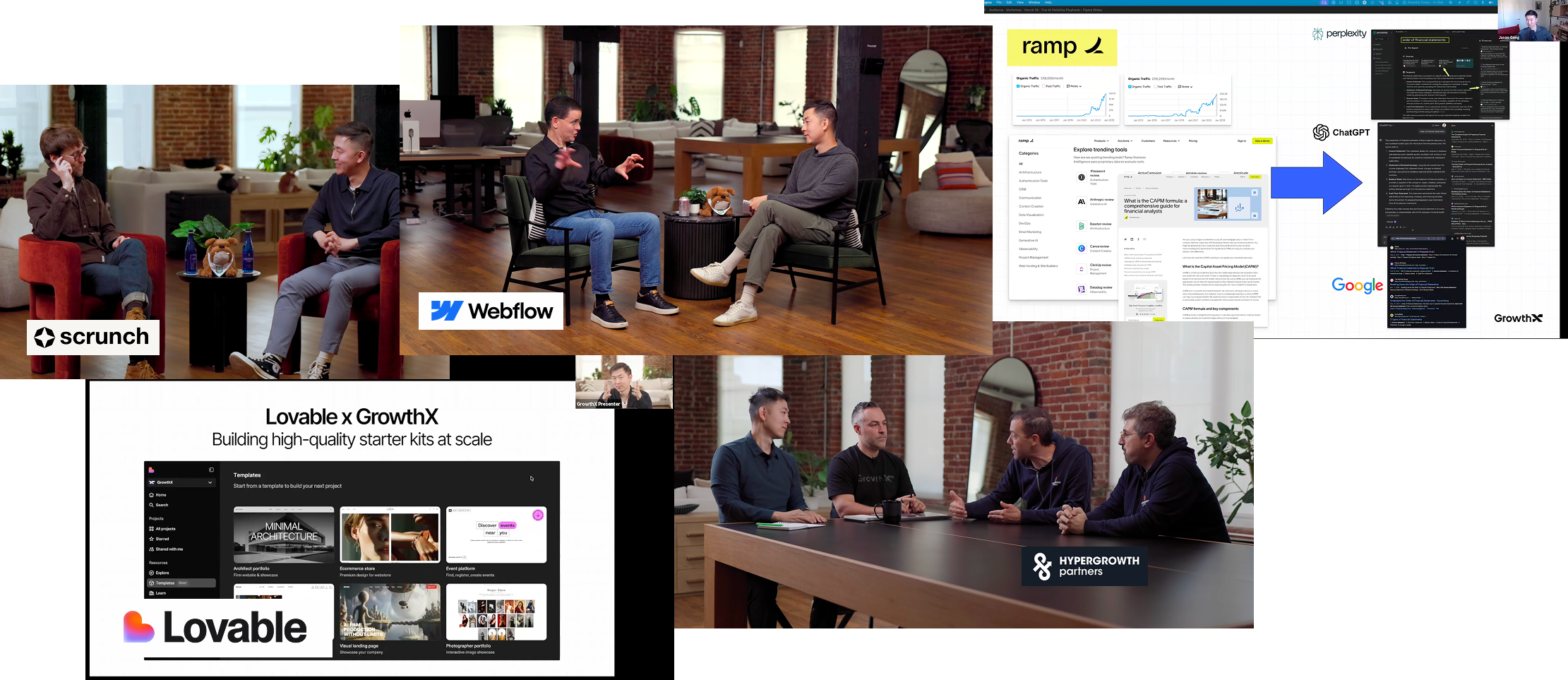
AI Visibility is being sold as the magic pill for growth in 2026. I just spent the last year running SEO and AEO programs for companies like Lovable, Webflow, and Augment Code, and teaching workshops on how to do it.
So it might surprise you that when people ask "Should we prioritize SEO or AEO right now?" I usually say:
Neither.
I'm a big believer that at most startups, one main channel usually drives 80% of the growth. Before you've found PMF and before you find that one "double-down" channel, SEO and AEO are almost always the wrong place to focus.
Why? The channel takes months to start working, is lower converting on average, and does not work well unless you can feed it from a gtm that's already working (i'll explain more below).
I wrote this post to help you think through this expensive investment decision. I'll cover what channels work by stage, what a working content program looks like, and how I'd invest in SEO and AEO when the timing is right.
What is SEO and AEO and why do people invest?
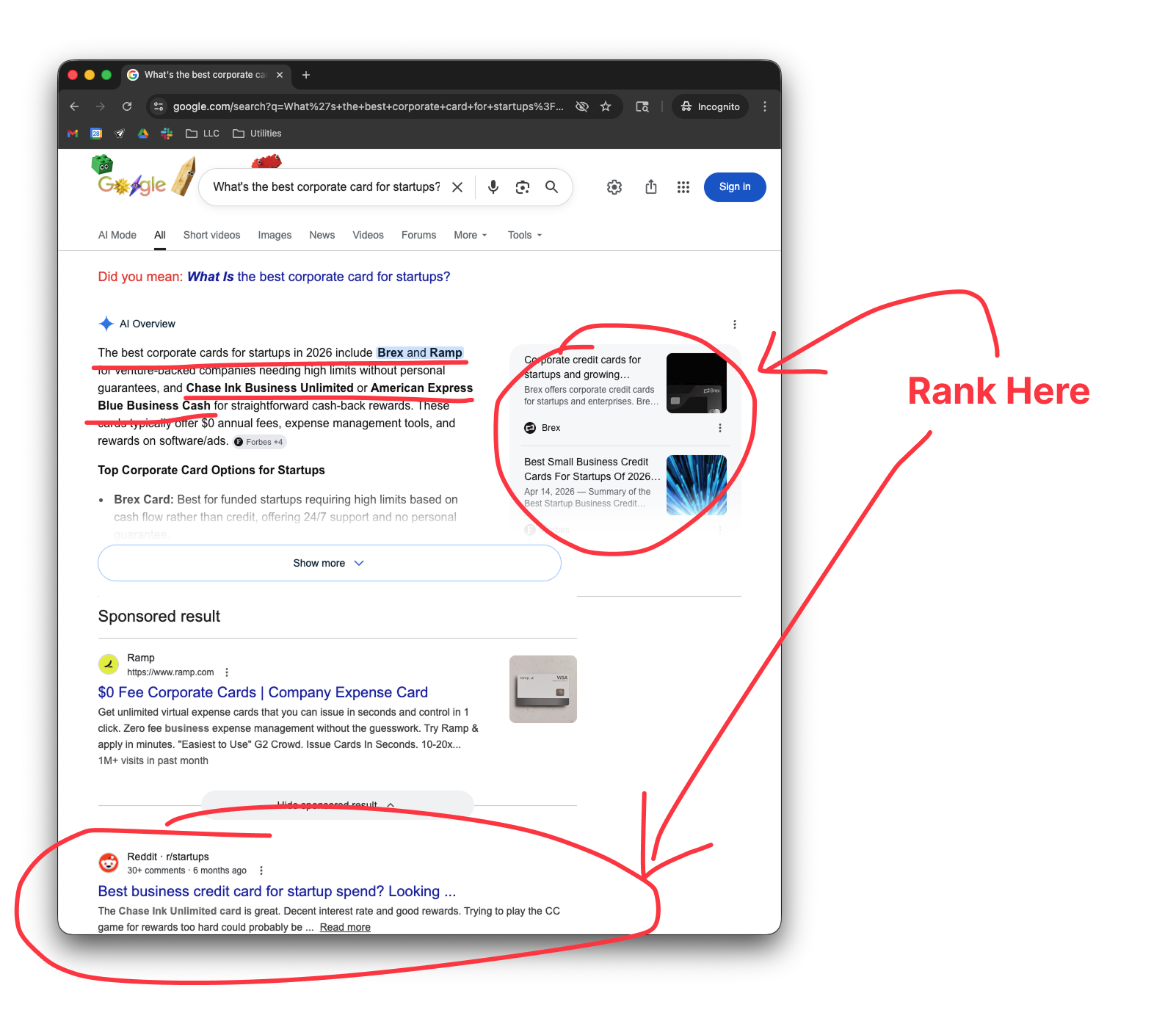
SEO (search engine optimization) is structuring your website so Google ranks your pages near the top when someone searches a relevant query. Links, content, technical hygiene, topical authority.
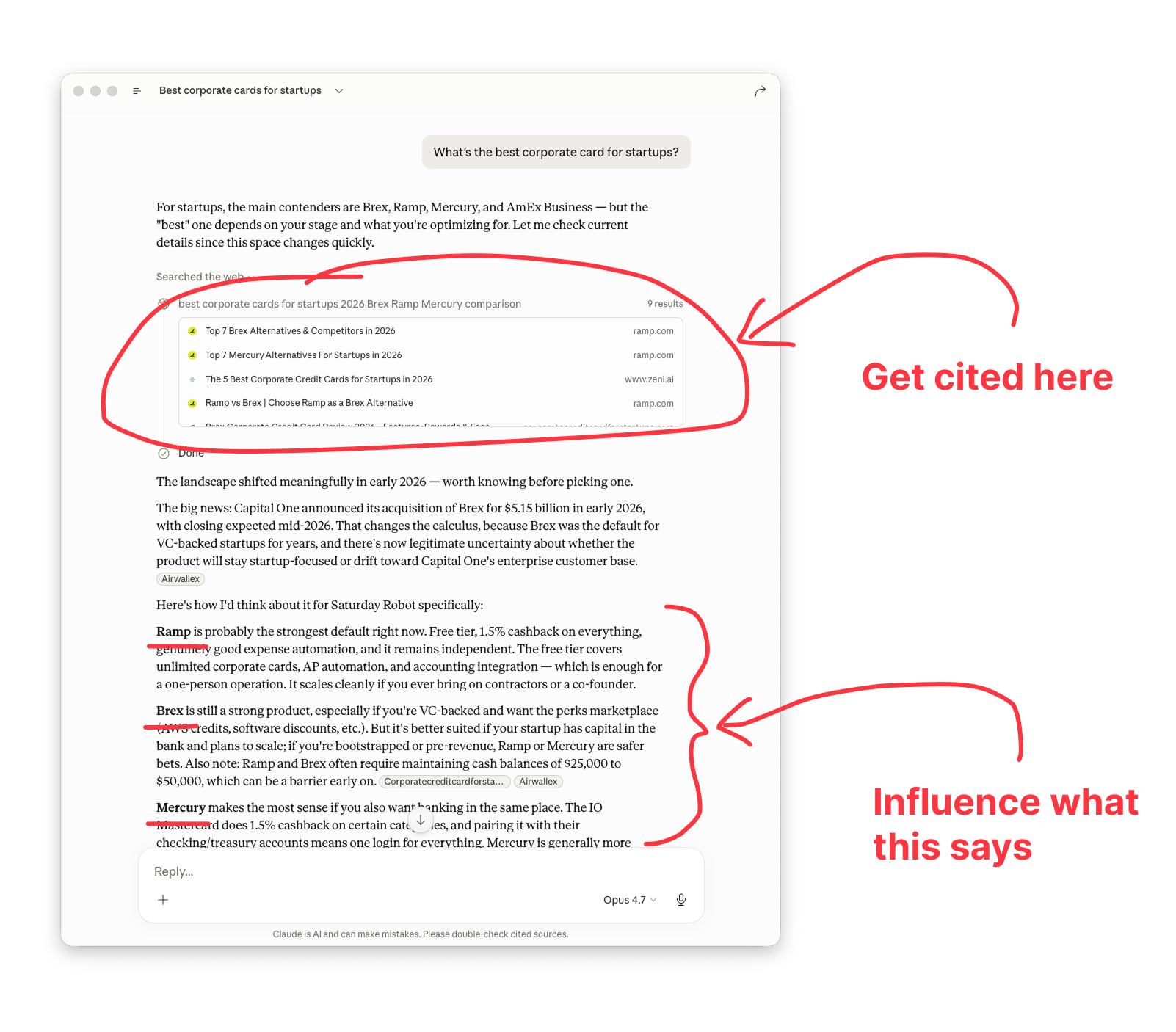
AEO (answer engine optimization) is the same job for AI assistants. When someone asks ChatGPT, Claude, Perplexity, or Gemini a question, the model picks which sources to read, cite, or paraphrase. AEO is the work of becoming one of those sources.
Why winning SEO and AEO pays off
A single keyword can be worth $10,000+ a month in value.
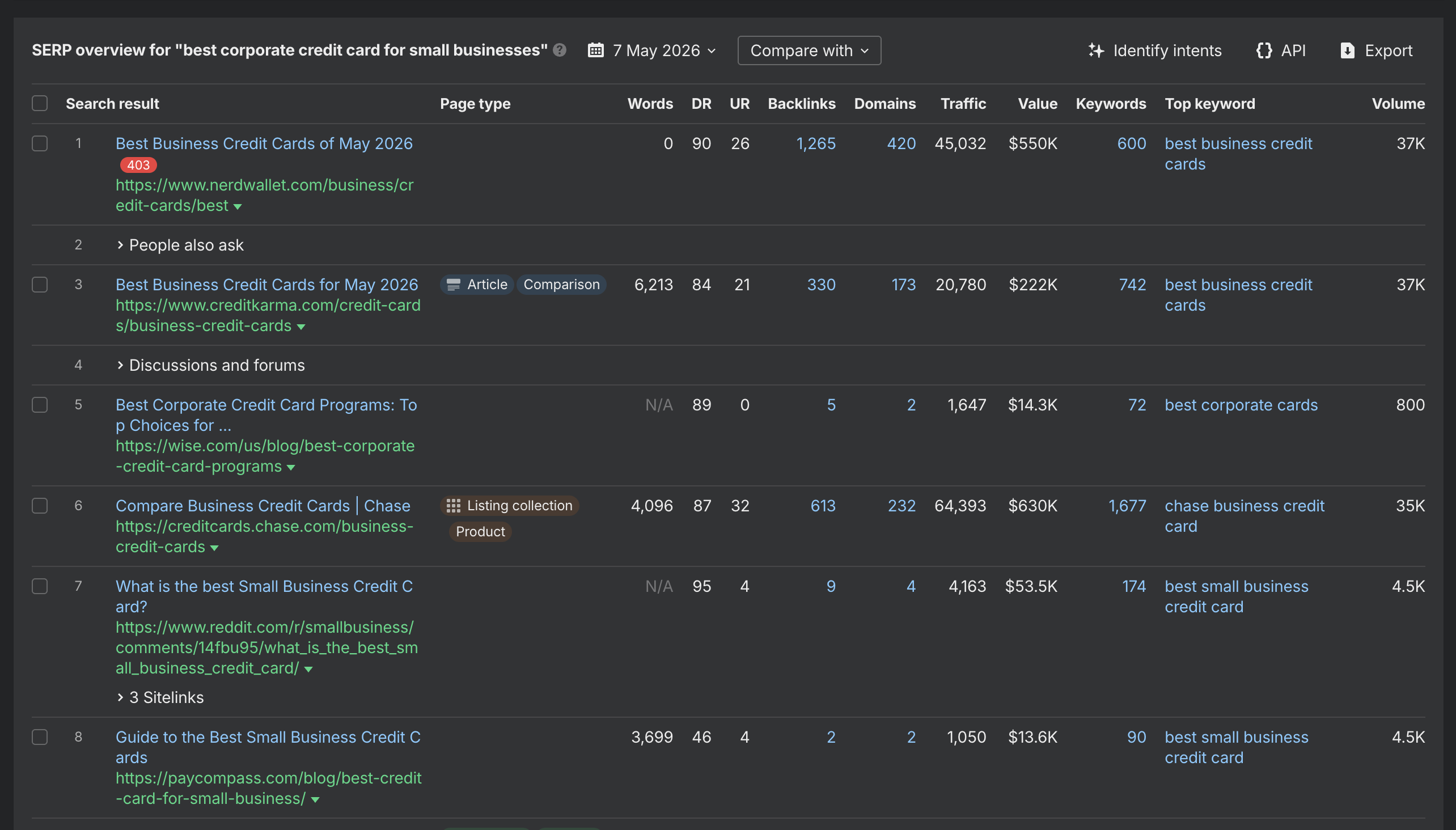
Take "best corporate credit card for small businesses." 600 monthly US searches directly, sitting under a parent topic ("best business credit cards") with 37,000 monthly.
The SERP is competitive: NerdWallet holds the top organic slot, Brex's own product page sits at position 10, and Ramp and Capital One are running paid ads at the bottom of the page.
For a self-serve product like Ramp or Brex, ranking near the top pays out across several layers:
- First-page traffic. NerdWallet's #1 article pulls roughly 45,000 monthly visits across the full keyword universe of that one URL. The article ranks for hundreds of related queries on top of this one.
- Ad-equivalent value. Ahrefs estimates that NerdWallet URL is worth ~$550K/month in traffic value (what you'd pay Google Ads to capture the same flow). Brex's product page at position 10 still pulls ~10K monthly visits worth ~$91K.
- Self-serve conversion. Brex's product page already gets ~10K monthly visits from this one cluster. At 1-2% visit-to-signup, that's 100-200 monthly signups from a single page.
- AEO citations. The companies ranking organically tend to be the ones LLMs cite. Asking Claude "what is the best corporate credit card for small businesses?" surfaces Brex, Ramp, Chase Ink, Amex Blue. The same brands ranking on page one of Google. Earn one ranking, earn the other.
- Ad displacement. Every organic click is one you didn't pay $9-12 CPC for. At first-page volume that's tens of thousands of dollars a month in ad spend you don't need to make.
And this is one keyword. A real program targets hundreds: every "best X for Y" variant, every "alternatives to," every category and competitor. The math is why the channel earns the investment when the inputs are right.
Both have the potential to be meaningful drivers of growth. You use these tools every day, and they shape what you buy and how you think. The question is timing.
Why SEO and AEO won't pay off (till later)
Across the go-to-market programs I've helped build, two patterns hold up.
Channels don't mold to products. Companies that try to force SEO onto a buyer who doesn't search, or content onto a still-emerging category, rarely get there. HubSpot was content because their CMOs google. Stripe was developer-led because developers read docs. You inherit the channel from where the buyer already lives.
The right channel also shifts with stage. The channel that teaches you the most pre-PMF rarely scales the most post-PMF. Founder sales teaches in days but caps at founder hours. SEO compounds at scale but teaches nothing in the first six months.
Here's how that could look for a sales-driven B2B SaaS business:
I lived this at Kite. We had 5 million Python developers a month on our docs site and tens of thousands of signups, and none of it moved the company forward meaningfully. Traffic can't fix a product that's not ready.
You can still publish. Just publish artifacts from what you're learning. A product page after ten sales calls. A customer story after one surprises you. The site gets stronger because you're codifying learnings into messaging and positioning, not in service of SEO and AEO.
Invest in content like a product
Most SEO programs feel disconnected from the actual company. The articles read like they could be for any competitor, don't sound like the actual product or sales conversations, and don't compound with anything else the company is doing. Founders who care about writing can spot this from a paragraph in.
In 2026, phoning it in on a growth channel doesn't work. It's way too competitive. People who build systems and use AI properly get 10x the results. Content is no different.
Treating content like a product fixes that. Hold it to the same bar as the rest of what you ship.
My mental model for nailing a good SEO/AEO program is three things: value, coverage, and progression.
1. Value
Are you actually delivering value to your ICP the same way your product does? Content earns the read the same way the product earns the install. A reader who finishes a piece should walk away with something they didn't have when they started: a sharper question, a tactic they'll use this week, a comparison they couldn't run themselves.
The closer the content sits to your actual work, the harder it is for a competitor to copy. When I ran go-to-market at GrowthX, our channel was workshops and dinners. Workshop recordings became video clips. The questions in the room became blog drafts that no competitor could write because they hadn't been in the room. Photos from dinners became social proof. Recaps gave us a reason to follow up. Posts brought more people into the next workshop. The same pattern works for almost any company: sales calls, customer consultations, case studies, candid product content, conferences.
When you get this right, prospects engage.
2. Coverage
Your GTM has gaps. There's usually a specific place where content can compound more than others. Maybe it's where you can't seem to build enough trust to turn attention into intent. Maybe you have a great product no one knows about (awareness). Maybe buyers research you in ChatGPT and the model describes your category wrong. Pick the gap, then build the coverage for it.
A buyer moves through three phases, and each one needs different content.
Aware of the problem. SEO's old dominant zone. Top-ranking "what is a CRM" articles drove huge awareness for HubSpot. AI has eaten most of this. Even when "what is" articles still rank, they rarely have an opinionated path to a product.
Aware of the problem and the products. Where most of the value is. "Best CRM for startups." "Alternatives to [competitor]." "Cheaper alternative for enterprise." These are the highest-CPA keywords on the planet because companies know this content converts. First Page Sage puts the bottom-of-funnel-to-top-of-funnel conversion ratio at roughly 25x. Comparison and alternatives pages are usually the highest-ROI pages on a site because the searcher is already shopping.
Evaluating your specific product. "Does Grant support international payments?" "Does Webflow integrate with Stripe?" For anything sold through procurement or sales, this content is the difference between a buyer who closes and a buyer who quietly disqualifies you.
3. Progression
A single piece of content, like a single call with a BDR, isn't going to convert someone on its own. It connects into a journey. You should understand the mindset of the reader coming in and where you want to drive them next.
HubSpot is the model. Almost every blog post carries three CTAs that push a template, calculator, checklist, or ebook. Almost none push a generic "sign up for HubSpot." The lead magnet captures the email; nurture moves people toward the product; the blog opens the ladder.
Progression also runs across channels. Build ad audiences from content engagement. Use the content itself as ad creative. Instead of a "sign up" ad, run a "read this" ad that nurtures into the product. Pull outreach lists from people who engaged with a specific piece. Use the language of high-performing pieces in sales decks and social copy.
If you're doing content and you're not running it as flywheel input, it'll land fourth or fifth on your priority list. And at that point, as a founder or a leader, you shouldn't be thinking about it that much.
AEO, how AI changed the ROI formula on content
What has ChatGPT and Claude done to SEO? They've increased the influence of content on buying decisions.
The behavior shift is obvious if you watch yourself. I use Google directly maybe a fifth as much as I used to. Claude, ChatGPT, Codex, and research agents touch the web for me ten times more often than I do manually. A single product evaluation prompt fires off ten or twenty searches and reads more pages than I'd ever open. The model gives the answer. The buyer often doesn't click through.
The bigger shift is trust laundering. Some fields haven't historically been driven by search influence: enterprise procurement, developers who'd never trust a random webpage served by Google's algorithm. Now they're served the same information synthesized into Claude or ChatGPT's output. The source gets obfuscated. You trust Claude.
Think of AEO as brand awareness work with a new set of buyers: Claude, ChatGPT, and Perplexity. They decide who gets cited and how a buyer is told about you. You have to win the model over before the human ever sees you.
And each cited page carries more weight than rankings ever did. The model reads dozens of pages, picks a handful, and the buyer treats those as the answer.
A few proof points from the last six months:
- Salesforce, holiday 2025: AI and agents drove $262B in retail revenue, about 20% of global holiday spend. Retailers running their own AI agents grew 59% faster year-over-year than peers.
- Adobe Analytics, holiday 2025: AI-driven traffic to US retail sites up 693% year-over-year in November and December. AI traffic converted 31% better than other sources. Revenue per visit on AI-referred sessions ran 254% above the YTD baseline.
- Adobe Analytics, Q1 2026: AI traffic to retail sites grew another 393% year-over-year. A year earlier, regular traffic was worth 128% more than AI on a revenue-per-visit basis.
- BrightEdge, holiday 2025: AI is still under 1% of total organic traffic at most large e-commerce brands.
The same trend shows up in my own work. At Webflow, about 8% of self-serve signups now come from LLMs and convert at six times the rate of non-branded organic search. And most companies I've advised or worked with see organic and brand traffic both improve when they invest in AEO. The buyer sees them cited in Claude's output, then types the company name into Google a few weeks later.
There are a few ways to influence what AI says about you, most of which come down to how your brand shows up across the web in the channels AI models are trained on and retrieved from. I'll leave a full breakdown for another article. Content makes up a significant portion of that influence, so here's what investing in content like a product actually means right now.
Short-term: stake your claim while the surface is still open
The first six to twelve months of any new channel is where the disproportionate gains live. Especially for a channel with momentum. SEO and AEO right now have a "stake your claim" window before the surface gets more competitive. The pages you publish today get indexed, cited, and locked in as the model's reference for your category. Wait twelve months and you'll be muscling against companies that already have those citations.
Long-term: build the muscle, because the bar keeps rising
Marketing is always going to be competitive. A lot of marketing is giving the buyer a signal that your product is worth their time to try. The way to create that signal has always been to invest more, and more tastefully, in channels that cut through the noise.
Writing content used to require real resources. A writer, an editor, weeks of time even for crappy content. The signal back then was simple: you searched, you found them, the ranking did the trust work for you. The bar has moved. Generic written content is cheap and easy now, which means it's noisy. Curated editorial with unique takes and first-hand data is what the signal looks like in 2026. So is original video. So are events, possibly the hottest channel right now. What's cheap and easy is noisy. The way to cut through is to invest where others won't.
If you believe AI will be a meaningful channel in how people discover new products, start investing now. The specific tactics for influencing AI will keep changing. The muscle and machinery behind it won't: producing strong content at scale, keeping your brand consistent across the web, capturing source material from sales and customers. Build that, and the tactic shifts take care of themselves.
Worth flagging the irony. I just spent a post arguing against SEO and AEO, and I sell this work. Now I'm telling the people who are ready to invest more, and earlier. The "ready" qualifier is doing all the work. Most companies still aren't.
What's next
For people investing in content, I'm working on a deeper dive into what you should actually invest in. The page types, the production setup, the order to do them in.
How that investment shifts based on where you are in the startup journey is its own piece. The engine that compounds for a Series B looks completely different at pre-seed.
If you want to talk this through for your company, reach out.
Field notes on growth from the best operators
Companies with unfair distribution win. I help unpack what top operators are learning and investing in to help you think through growth.