
AI visibility is being sold as the magic pill for growth in 2026. I spent the last year running SEO and AEO programs for companies like Lovable, Webflow, Surge AI and Augment Code, and teaching workshops on how to do it.
When people ask "Should we prioritize SEO or AEO right now?" I usually say:
Neither.
If you haven't found PMF yet or a channel already growing the business, SEO and AEO are almost always the wrong place to focus.
Organic search takes months to start working, converts lower on average, and doesn't do much unless you can feed it from a go-to-market that's already converting.
Quick primer: SEO and AEO
SEO, or search engine optimization, is about structuring your website so that Google ranks your pages near the top when somebody searches a relevant query. Links, content, technical hygiene, topical authority.
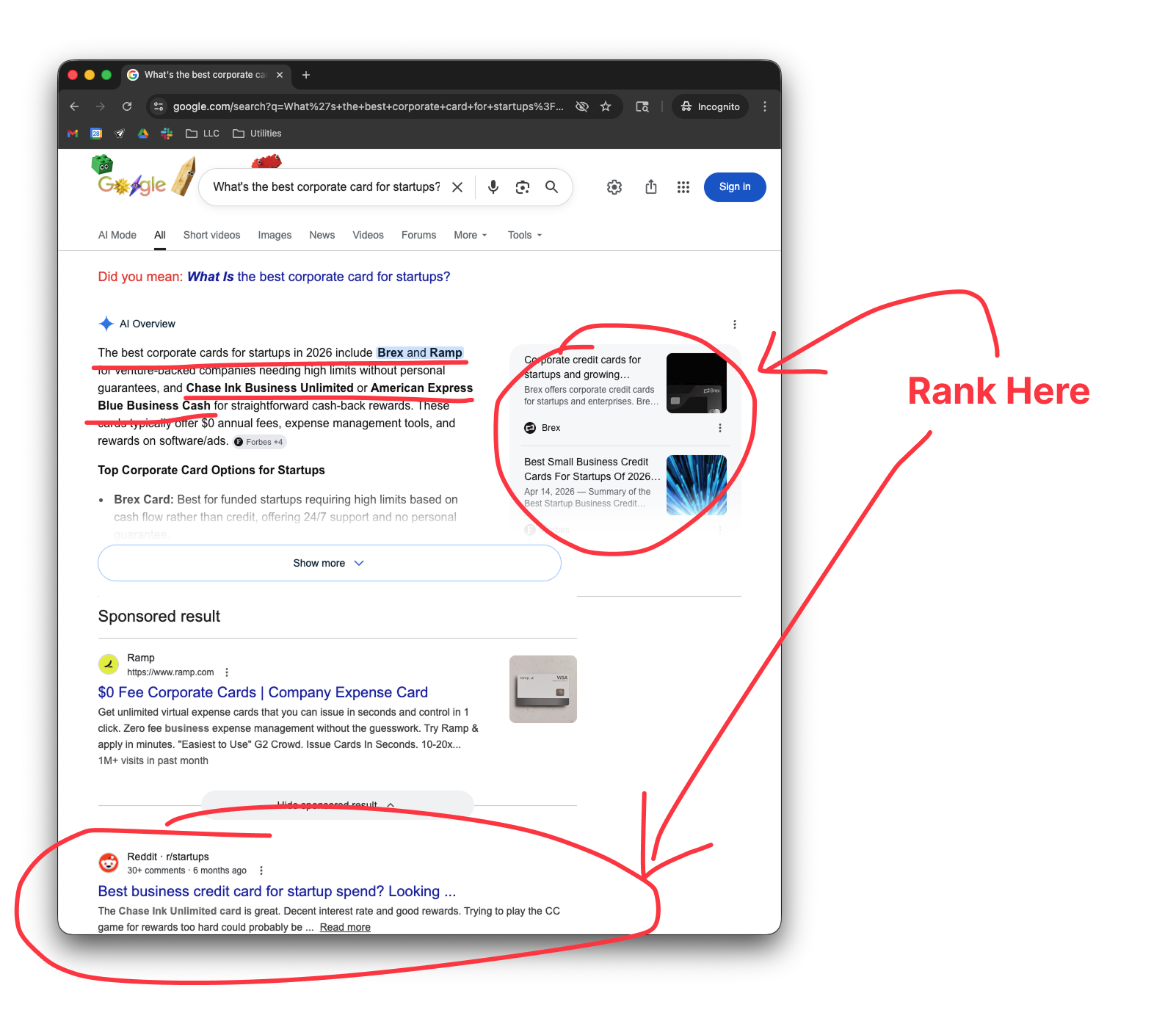
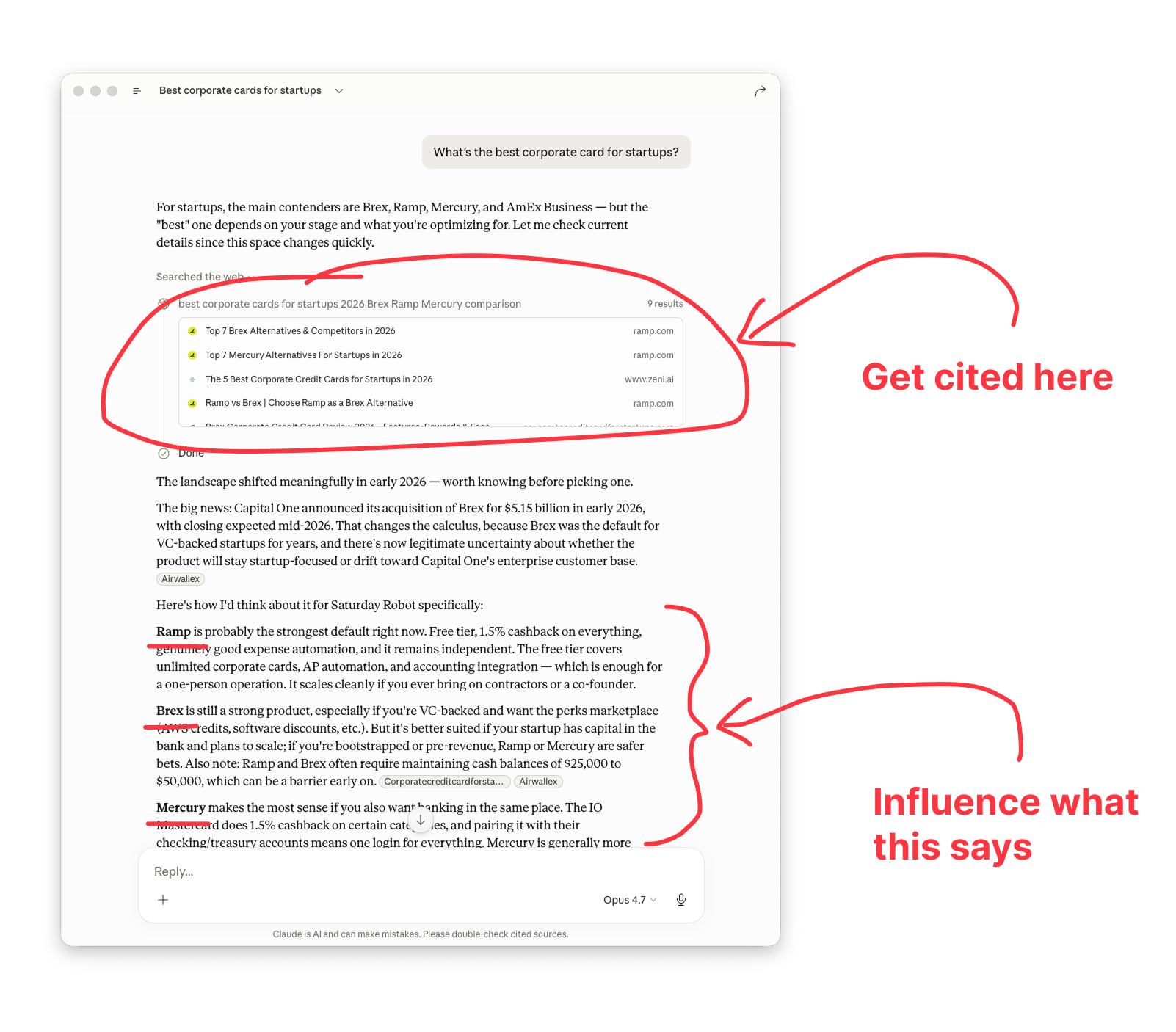
AEO, or answer engine optimization, is that same job for AI assistants. Somebody asks ChatGPT, Claude, Perplexity, or Gemini a question, and the model picks which sources get read, cited, or paraphrased into the answer. AEO is the work of becoming one of the sources it picks.
Why do people invest in SEO and AEO?
A single keyword can be worth $10,000+ a month, and a family of related prompts (the AEO equivalent) is worth even more than that.
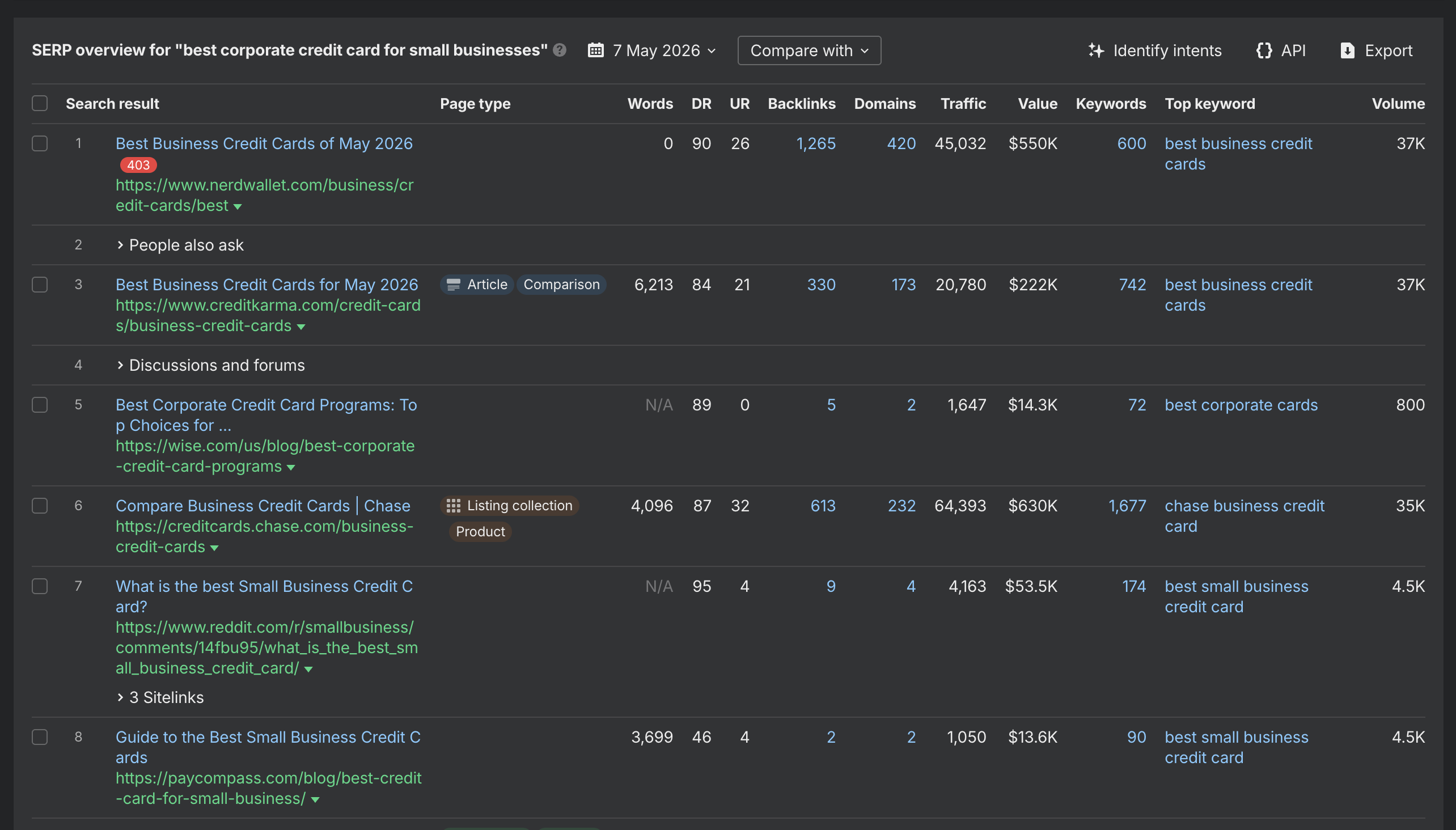
Take "best corporate credit card for small businesses". The phrase itself does 600 US searches a month, and its parent topic, "best business credit cards", does 37,000/mo. Now look at page one for it. It's a competitive page. NerdWallet holds the top organic slot. Brex's product page is buried at position 10. Ramp and Capital One are paying for the ads at the bottom.
For a self-serve product like Ramp or Brex, a top ranking pays out a few ways.
The obvious one is traffic. NerdWallet's #1 article pulls ~45,000 monthly visits across hundreds of related queries. Buying that through Google Ads would run you ~$550K/mo, and some slice of those visits becomes self-serve signups on top.
The less obvious one is that the brands ranking organically tend to be the ones LLMs cite. Ask Claude for the best small-business card and it gives you Brex, Ramp, Chase Ink, and Amex, the same names already competing on page one.
And this is one keyword, remember. A real program targets hundreds of them. Every "best X for Y". Every "alternatives to". Every category, every competitor. Nobody's going to hand you a clean ROI number on this, same as nobody hands you one for a brand survey, but influencing what the models say is worth something real. The question is when to invest.
Organic is slow, but you need to learn fast
If you don't have strong PMF, your constraint as a founder is time: how fast you can iterate the product. So founder sales, warm intros, events, direct outreach. Those work best here. None of these scale incredibly well, but you get unfiltered access to your buyers out of them.
Organic content is too slow and too detached to help here. A new site has zero authority, so content takes 3-6 months to even rank. That's 3-6 months of guessing at what your buyer wants instead of hearing it from them. Like stopping mid-hike to build a suspension bridge over a pond you could wade across in a minute.
I got to experience this first-hand. At Kite we had 5 million Python developers a month on the docs site and tens of thousands of signups. None of it moved the company forward in any meaningful way. Traffic can't fix a product that's not ready.
One channel usually drives most of the growth
The companies growing fastest understand how the full distribution stack fits together. Somewhere inside it, they find one channel and become disproportionately, almost irrationally good at it.
GrowthX was like this. Most of our pipeline came from events, both in-person and virtual. We sold a new category, so we used two-hour workshops to teach it and dinners in SF to build trust. SEO, for us at that point, would have been a waste of time.
These channels usually come out of advantages you already have: a founder who can sell, a network you can mobilize, or a wedge audience that trusts you. Organic content rarely wins from a standing start. It helps once a channel is converting and producing sales calls and customer wins that can become pages.
Here's how that priority shifts by stage for a sales-driven B2B SaaS business:
I would look for it in this order:
- Write down your unfair advantages. A founder who can sell, a network you can mobilize, a wedge audience that already trusts you, a distribution edge. The channel tends to come out of one of these, and you won't find it on a best-practices list.
- Run small, real tests on the two or three channels that teach you fastest. Founder sales, warm intros, events, direct outreach, that kind of thing. Three answers you want before any money goes in: who buys and the job they're hiring you for, how quickly the channel gives you buyer feedback, and whether its attention turns into pipeline you can predict.
- Watch for the channel that converts and that you can push harder on without it breaking. A channel that converts but caps at ten conversations a week is a different bet than one you can keep feeding.
- When you find it, concentrate there until it's clearly working before opening a second channel. The usual failure is five half-channels because one of them twitched: a little SEO, a little founder social, a little outbound, a few events, no real force behind any of it.
- Until then, only publish artifacts from what you're learning. A product page after ten sales calls, a customer story after one surprises you. The site's getting stronger because the positioning is getting codified, and rankings have nothing to do with it (yet).
AEO changed the math, so "wait" doesn't mean "ignore"
I use Google directly maybe a fifth as much as I used to. One product-evaluation prompt fires off ten or twenty searches, reads more pages than I'd ever open, and hands the answer back. A lot of the time the buyer never clicks through to anything.
Trust laundering is the bigger shift, though. Enterprise procurement teams and developers often did not trust a random Google result. Now they're getting the same information synthesized inside Claude or ChatGPT. The source gets obfuscated and the model ends up holding the trust. AEO becomes brand work aimed at Claude, ChatGPT, and Perplexity: which companies they cite and how somebody hears about you the first time.
Webflow gets about 8% of self-serve signups from LLMs now, and those convert at six times the rate of non-branded organic search. Adobe Analytics measured AI-driven traffic to US retail sites up 693% year-over-year over the 2025 holidays, converting 31% better than other sources too.
What's next
Say you're past the bar. You know who buys, a channel works, and there's source material to pull from. The plan I'd run to build an AEO program covers the two things that stay true as the tactics change, plus the order I'd do the work in.
If you want to talk any of this through for your company, reach out.
Get the next post in your inbox
Companies with unfair distribution win. I'm collecting field notes from the world's best operators to help you think through growth.
Join top operators from Zapier, Clay, Lovable.